No. A flat iron is not a head lice treatment. The AAP says the most effective way to treat head lice is with head lice medicine, and the one place the CDC’s clinical care guidance mentions flat irons is a safety note on malathion lotion, a flammable medicine: no electrical heat sources, flat irons included, while that lotion is applied and the hair is wet. The heat in lice guidance goes to combs, brushes, clothing and bed linens, not to hair. The CDC, the American Academy of Pediatrics and MedlinePlus are all specific about where heat helps, why eggs are the hard part, and what actually treats lice.
What Does CDC Guidance Say About Hot Tools on Hair?
It mentions them in one place, and that place is a flammability warning for one medicine. The CDC’s clinical care guidance on head lice says, in its entry for malathion lotion, that the lotion can irritate skin and is flammable, and not to smoke or use electrical heat sources, including hair dryers, curlers, and curling or flat irons, when applying it and while the hair is wet. No technique is attached, no temperature and no timing, because the line is not advice about how to apply heat to hair. It is a fire-safety instruction for one lotion.
The reason is flammability. The CDC says malathion lotion can irritate skin and is flammable. The AAP’s treatment table carries the same warning on a product in two words: strong odor, flammable. Its myths page says of products it warns against that they are flammable, carrying substantial risk. MedlinePlus is blunt about the worst of the household substitutes: you should not use kerosene or gasoline, because they are dangerous and flammable. Cigarettes, open flame and electrical heat do not belong near a head with a flammable lotion on it.
The same guidance treats lice medicine as a drug rather than a shampoo. The CDC says the drugs used to treat lice are insecticides and can be dangerous if misused or overused, that you should not use extra amounts of any lice medication unless your physician and pharmacist instruct it, and that you should not use different head lice drugs at the same time unless a healthcare provider or pharmacist tells you to. The AAP adds that medicine should be applied by an adult, that children should never apply it, and that a child should not be left alone with medicine in his or her hair.
A flat iron belongs to a larger family of household shortcuts, and the sources give those shortcuts one answer. The AAP says not to use home remedies such as petroleum jelly, mayonnaise, tub margarine, essential oils or olive oil, because no studies prove they work. The CDC says it does not have scientific evidence that suffocating head lice with mayonnaise, olive oil, margarine, butter or similar substances is an effective form of treatment. The same reasoning runs through whether hair dye kills head lice and what the evidence says about tea tree oil.
Where the Eggs Sit and How Long They Take to Hatch
Eggs are the reason this question has a hard answer, and it is because of where they are attached. The AAP says lice lay and attach their eggs to hair close to the scalp, that eggs are usually found within 4 to 6 mm of the scalp, and that they do not survive if they are farther away. The CDC puts the same band in inches: look for nits attached firmly within a quarter inch of the base of hair shafts, and nits attached more than a quarter inch from the base are almost always hatched or dead. Living eggs sit in a few millimeters of hair pressed against the skin.
Two things about that band matter. The CDC says eggs cannot hatch and usually die within a week if they are not kept at the same temperature as those found close to the scalp. Scalp warmth is a condition of hatching. And they are not resting on the hair. The AAP says nits attach to the hair with a sticky substance that holds them firmly in place, which is also how a parent tells them apart from debris: nits are firmly attached to hair, while dandruff, dirt or other particles are not.
The clock is why timing matters for any treatment. The CDC says nits take about a week, in a range of 6 to 9 days, to hatch into nymphs, and that nymphs take about seven days to mature into adult lice. The AAP gives 7 to 12 days for hatching, depending on the surrounding temperature. An adult female lays about six eggs a day by the CDC’s count.
This is also why treatment labels care about eggs at all. The CDC says some medicines kill lice and eggs, and that retreatment is usually not required for those, while other medicines kill lice but are not effective at killing eggs, so retreatment is recommended. If a medicine does not kill eggs, the CDC says to treat again about a week after the first treatment, 7 to 9 days depending on the drug, after all eggs have hatched but before new eggs are produced. That one difference, whether a product reaches the eggs, is the whole subject of whether a drugstore lice shampoo kills the eggs.
Where Heat Does Belong When a Household Has Lice
Heat does appear in lice guidance, and this is where. The CDC tells you to soak combs and brushes in hot water, at least 130 degrees Fahrenheit, for 5 to 10 minutes, and to run washable items through the hot water laundry cycle at 130 degrees Fahrenheit with the high heat drying cycle. That raises a fair question: if heat handles the comb and the pillowcase, why not the hair? These measures are for combs, brushes and items a person with lice wore or used in the two days before treatment, not for the head.
| Item or area | What the CDC says to do |
|---|---|
| Combs and brushes | Soak them in hot water, at least 130 degrees Fahrenheit, for 5 to 10 minutes. |
| Clothing, towels and bed linens | Machine wash and dry them, using the hot water cycle at 130 degrees Fahrenheit and the high heat drying cycle. |
| Items you cannot wash or dry clean | Seal them in a plastic bag and store them for two weeks. |
| Floors and furniture | Vacuum the floor and furniture, particularly where the infested person sat or lay. |
| Fumigant sprays and fogs | Do not use them; they are not necessary to control head lice and can be toxic if inhaled or absorbed through the skin. |
| Hair, while malathion lotion is applied and the hair is wet | Do not smoke or use electrical heat sources, including hair dryers, curlers, and curling or flat irons. |
The CDC’s framing of that list is worth keeping in view. It says that in addition to medications you can use extra measures to manage lice, but these are usually not necessary, and that spending much time and money on housecleaning activities is not necessary to avoid reinfestation. It also says the risk of getting lice from a louse that has fallen onto a rug, carpet or furniture is very small. Head lice will die within two days if they fall off a person and cannot feed, by the CDC’s account; the AAP says they cannot survive more than one day without a blood meal.
Two warnings sit alongside the laundry advice. The AAP says not to spray pesticides in your home, and both the AAP and its myths page warn never to place a plastic bag, or anything made of plastic, on a child’s head; a bag is for sealing items, not for covering hair.
What the CDC and the AAP Say Actually Treats Lice
Medicine does the work, and the call to the doctor comes first. The AAP says the most effective way to treat head lice is with head lice medicine, and that you should check with your child’s doctor before beginning any head lice treatment. The CDC says you can treat head lice with medications, called pediculicides, that are either over the counter or by prescription, and that medications are generally safe and effective when used correctly. Both put the same condition on it: treat when there is an active infestation.
The instructions on the box are the instructions. The CDC says to use the lice medicine as directed on the box or label and to follow all provided instructions; the AAP says to follow the directions on the package exactly as written. Two details are easy to miss. The CDC says not to use a combination shampoo or conditioner, or conditioner, before using lice medicine, and not to re-wash the hair for 1 to 2 days after removing it.
Patience is part of the instruction too. The CDC says it takes time to kill all the lice, and that if you notice a few lice still moving slowly 8 to 12 hours after treatment you do not need to reapply the medicine. If you find no dead lice, or the lice seem as active as before treatment, the CDC says the medicine may not be working, and to talk to a healthcare provider before re-treating. For medicines that do not kill eggs, it says to treat again about a week after the first treatment, 7 to 9 days depending on the drug. The CDC lists five reasons a treatment fails:
- Misdiagnosis
- Recent application of combination shampoo or conditioner, or conditioner, to hair
- Not following treatment instructions
- Head lice resisting the medication
- Reinfestation after successful treatment
Resistance is the one on that list parents cannot see. The AAP says head lice can be resistant to the active ingredients in over the counter treatments in some communities, and that the likelihood of resistance varies across the country. Its advice is to call the pediatrician before treatment, because a pediatrician can help you choose an appropriate treatment option for your child. The CDC adds a hard stop: do not treat a person more than 2 to 3 times with the same medication if it is not succeeding.
One more piece is easy to skip when everyone is tired. The CDC says to check all household members and other close contacts for head lice, and to treat everyone who is infested, including people they share a bed with, at the same time. The AAP and MedlinePlus say the same: all household members and close contacts should be checked and treated if necessary. A head that is treated alone can be reinfested by a head that was not checked.
How Do You Check a Head Carefully Instead?
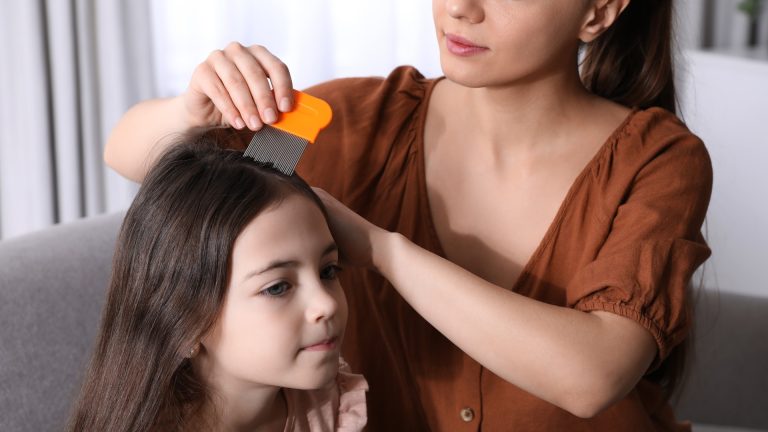
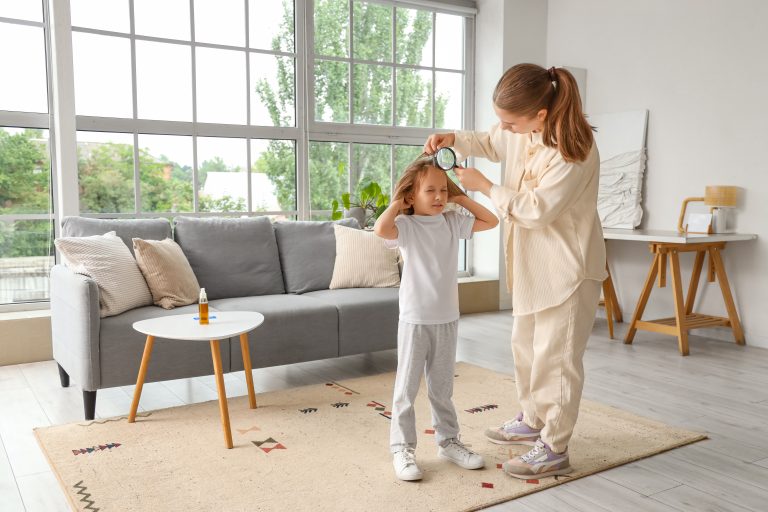
Bright light, small sections and a fine-toothed comb do what a hot tool cannot. The AAP describes seating the child in a brightly lit room, parting the hair, and looking for crawling lice and nits on the scalp a section at a time; MedlinePlus adds that the parting should go all the way down to the scalp in very small sections. The CDC says a fine-toothed louse comb may help you find lice, and that although lice and nits can be visible with the naked eye, a magnifying lens may help.
Two facts make careful checking worth the time. The CDC describes adult head lice as roughly 2 to 3 mm long, about the size of a sesame seed, and says that because adult and nymph lice are very small, move quickly and avoid light, they may be difficult to find; the AAP agrees that live lice are hard to find. The CDC also says misdiagnosis of head lice infestation is common, and that nits are often confused with dandruff, hair spray droplets and dirt particles. The AAP’s rule for medicine applies to any plan: head lice medicine should be used only when it is certain that your child has living head lice.
Symptoms are a reason to look, not a verdict. The CDC says itching is the most common symptom and that it comes from an allergic reaction to louse bites; a tickling feeling or a sensation of something moving in the hair, irritability and sleeplessness, and sores from scratching can come with it. The CDC also says people may have no symptoms at all, particularly with a first infestation or a light one. Two timing details matter: the CDC says it may take four to six weeks for itching to appear the first time, and the AAP says itching can last for weeks even after the lice are gone.
Two places are worth the most attention. The CDC says you will often see nits on hair behind the ears and near the back of the neck, and the AAP says the easiest place to find them is at the hairline at the back of the neck or behind the ears. Finding a live nymph or adult louse on the scalp or hair is, in the CDC’s words, the best way to diagnose a head lice infestation. If you are not sure, the CDC says to see your healthcare provider.
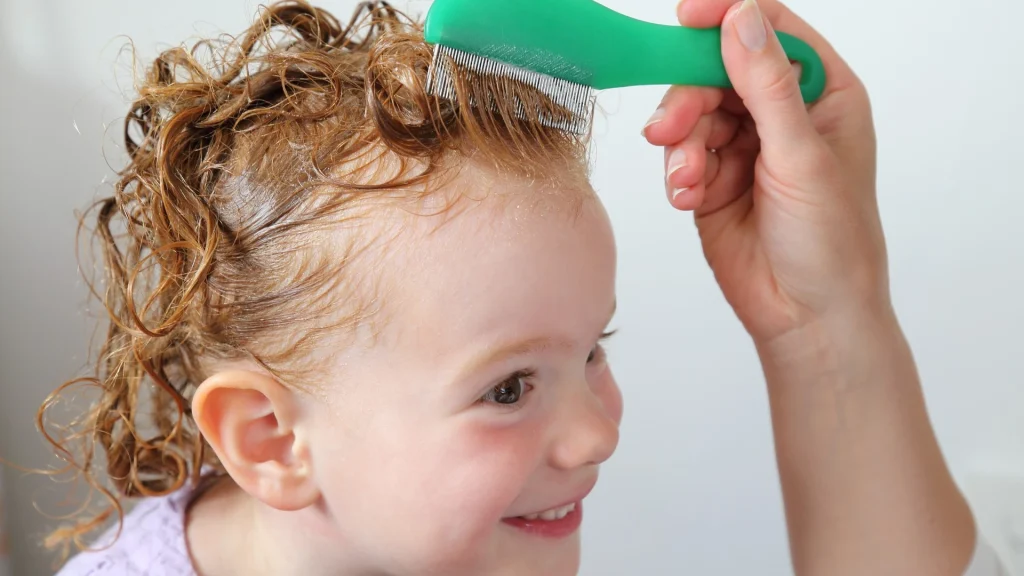
The AAP’s comb-out method runs in four steps.
- Wet the child’s hair.
- Comb through the hair in small sections with a fine-tooth louse or nit comb.
- After each comb-through, wipe the comb on a wet paper towel, then examine the scalp, the comb and the paper towel carefully.
- Repeat until you have combed through all of the hair.
The CDC notes that flea combs made for cats and dogs are also effective. What combing is for matters as much as how it is done. The AAP says the comb-out method can be used to help check for nits and head lice, and that it usually does not work on its own to get rid of head lice. After treatment, the AAP says combing out every 2 to 3 days for 2 to 3 weeks may help remove nits and eggs, and MedlinePlus says to keep that up for 2 to 3 weeks to be sure all lice and nits are gone. Our post on how fast lice move adds more on why the AAP asks for a lit room and small sections.
Frequently Asked Questions
Does a flat iron kill lice eggs?
No. In the CDC and AAP material, what deals with eggs is the choice of medicine: some medicines kill lice and eggs, and others kill lice but not eggs, which is why a second treatment is sometimes recommended. Viable eggs are glued within 4 to 6 mm of the scalp, and the only mention of flat irons in the CDC’s clinical care guidance is a fire-safety note for malathion lotion.
Is it safe to straighten hair during a lice treatment?
Not while malathion lotion is on the hair. For that lotion, the CDC says not to smoke or use electrical heat sources, including flat irons, when applying it and while the hair is wet, and it calls the lotion flammable. The AAP’s product note reads strong odor and flammable. For any other product, and for when it is safe to style again, the label and your child’s doctor are the ones to ask.
Would a hair dryer or curling iron work instead?
The same malathion note covers them. The CDC names hair dryers, curlers, and curling or flat irons together as electrical heat sources to avoid while that lotion is applied and the hair is wet. The treatment guidance in the CDC, AAP and MedlinePlus material is built around medicine, combing and the egg cycle, so swapping one hot tool for another changes the appliance and not the answer.
What temperature does lice guidance actually use?
The CDC’s number is 130 degrees Fahrenheit, and it is for objects. The CDC uses it for soaking combs and brushes for 5 to 10 minutes and for the hot water laundry cycle, paired with high heat drying. MedlinePlus describes the same washing and drying for clothes, bedding and towels, and the same 5 to 10 minute soak for combs and brushes.
If the lice seemed gone after a hot-tool pass, can they come back?
Yes, and the timeline is in the sources. Eggs already attached near the scalp hatch in 6 to 9 days by the CDC’s range and 7 to 12 days by the AAP’s. That is why both bodies ask for repeat checks every 2 to 3 days for 2 to 3 weeks.
How do I know it is lice and not dandruff?
Attachment is the test. The AAP says nits are firmly attached to hair while dandruff, dirt and other particles are not. Nits look like small white or yellow-brown specks close to the scalp, oval and about the size of a knot in thread, and the AAP notes some blend in with a person’s hair color. Loose flakes that lift away are something else.
Does straightening or styling hair help prevent head lice?
Prevention in these sources is about contact, not hair texture. The CDC says head lice spread mainly by head-to-head contact, that they crawl rather than hop or fly, and that getting them is not related to cleanliness. Its advice is to teach children to avoid hair-to-hair contact during play and not to share combs, brushes, towels, hats, scarves or hair ribbons.
How Lice Lifters of Chester County Can Help
If the checking is the part you dread, we do that part. Lice Lifters of Chester County checks the whole family, because the CDC and the AAP both ask for household members and close contacts to be checked, and one unchecked head is how a household starts over. Our treatment is non-toxic and done in one visit, and we offer same-day appointments, so a discovery on a weeknight does not have to become a week of guessing. Our 30 Day Guarantee applies when the whole family is checked. The professional lice treatment page walks through what a visit involves, and you can book a head check when you are ready. The flat iron can go back to styling hair.