
Yes, Black children can get head lice, although the CDC reports that infestation in the United States is much less common among African American persons than among persons of other races. Less common is not the same as never, and the AAP says plainly that anyone can get head lice. That difference matters at home, because a parent who believes a child cannot catch lice may skip the careful look that would find a case before it reaches siblings and caregivers.
Is It Rare for Black People to Get Lice?
Less common is the accurate description; rare goes further than the evidence does. The CDC’s wording is “much less common,” and it describes how infestations are distributed among groups of people across the country. A comparison between groups of people cannot tell you whether the child in front of you has lice tonight.
That is why a lower rate is not a substitute for checking. The CDC notes that people with head lice may not have symptoms, particularly with a first infestation or when an infestation is light. It may take four to six weeks for itching to appear the first time a person has head lice, so a child who is not scratching can still be carrying them. When symptoms do show up, the CDC lists itching, a tickling feeling or a sensation of something moving in the hair, irritability and sleeplessness, and sores on the head caused by scratching.
The CDC also states that “misdiagnosis of head lice infestation is common,” and that mistake can run in both directions. A family convinced that lice cannot happen may overlook a real case, while another family may mistake dandruff or hair spray droplets for eggs. A careful check answers the question better than any assumption about who gets lice and who does not.
Why Do Lice Grip Some Hair More Easily Than Others?
The CDC points to the louse itself: head lice may have claws that are better adapted for grasping the shape and width of some types of hair, but not others. The CDC sets that idea beside its note on lower rates, as a possibility rather than a proven cause. It does not rule anyone out.
Pay attention to the word “may.” It marks a possible explanation, not a guarantee, and a claw that holds some hair less easily is still a claw that can hold on. The AAP’s guidance includes a short line that settles the question for parents: anyone can get head lice.
Two related beliefs are worth clearing up as well. One is that clean hair or frequent washing keeps lice away. The CDC states that getting head lice is not related to cleanliness of you or your environment, and the AAP adds that it doesn’t matter if the hair is clean or dirty. The other belief is that finding lice means something is wrong with the family. It does not. Head lice do not transmit any disease, the CDC says, and the AAP notes that they don’t cause serious illness.
For parents of children with 4C or other tightly coiled hair, the takeaway is straightforward. The CDC’s lower rate describes a group, not your child, and it is not protection: a known exposure, a tickling feeling or a scalp your child keeps touching is still a reason to look.
How Do Lice Spread Through a Household?
Head lice mainly spread by direct contact with the hair of a person infested with lice, so the people who share close time and space with that person are the ones exposed. MedlinePlus puts it this way: “Children ages 3-11 and their families get head lice most often.” For a household, the useful question is not who seems likely to get lice, but who has been in head-to-head contact with someone who has them.
Lice move by crawling; the CDC says they cannot hop or fly. Spread through shared belongings is less likely. The AAP describes a very small chance of spread through items such as combs, brushes, hats and sports helmets, and MedlinePlus says this happens rarely. Animals do not get or spread head lice. Chlorine levels in pool water do not kill lice, though the CDC says they are unlikely to spread in a swimming pool.
Families who use wigs or hairpieces can take some reassurance from the CDC, which says contracting lice from a wig or hairpiece is extremely unlikely, especially if it hasn’t been worn in the past 48 hours by a person with head lice.
The prevention steps the CDC and MedlinePlus describe center on contact and sharing:
- Avoid head-to-head contact during play and other activities at home and elsewhere, such as sports, playgrounds, slumber parties and camp.
- Do not share combs, brushes or towels.
- Do not share hats, scarves, coats, sports uniforms, hair ribbons or barrettes.
- Teach children not to share items they put on their heads, such as headphones, hair ties and helmets.
- Avoid lying on beds, couches, pillows, carpets or stuffed animals that have recently been in contact with a person who has head lice.
Hair length comes up in these conversations too, and we look at it in does cutting your child’s hair short really prevent lice.
How to Check Curly, Coily or Braided Hair for Lice
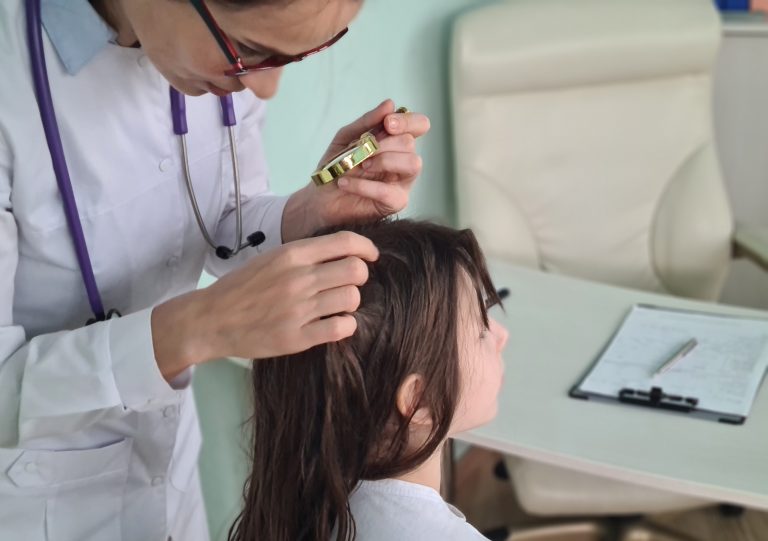
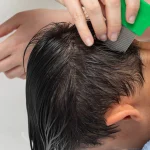
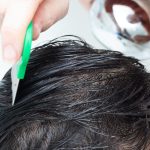
Check textured hair the way the AAP and MedlinePlus describe for any child: bright light, parts that reach the scalp and a fine-tooth comb worked through small sections. MedlinePlus advises parting the hair all the way down to the scalp in very small sections, which lets you see the skin even where curls and coils are dense.
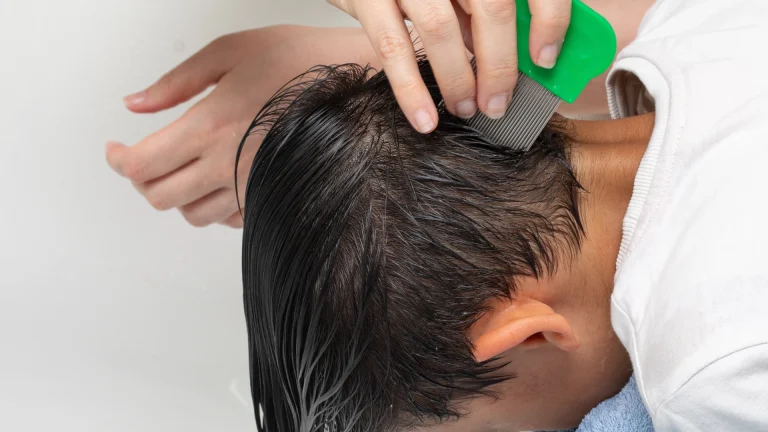
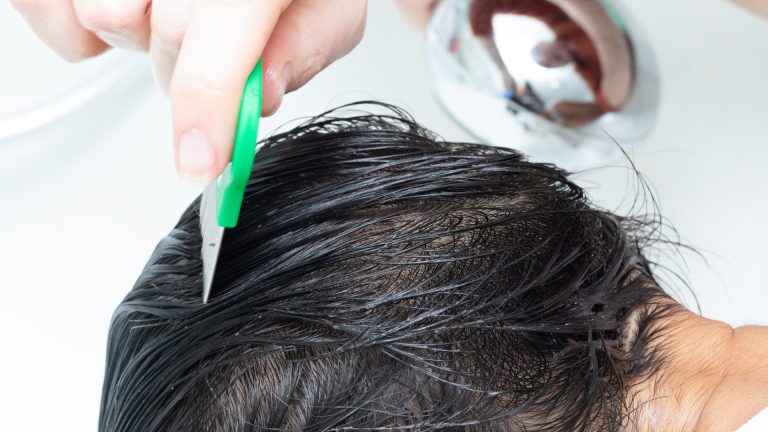
The AAP says its comb-out method can be used to help check for nits and head lice. Its steps, in order:
- Seat your child in a brightly lit room, part the hair and look for crawling lice and nits on the scalp a section at a time.
- Wet your child’s hair.
- Comb through the hair in small sections with a fine-tooth louse or nit comb.
- After each comb-through, wipe the comb on a wet paper towel, then examine the scalp, the comb and the paper towel carefully.
- Repeat until you have combed through all of your child’s hair.
The AAP says the easiest place to find nits is at the hairline at the back of the neck or behind the ears, and the CDC agrees: “You will often see nits on hair behind the ears and near the back of the neck.” Live lice are hard to spot because they avoid light and move quickly, and the CDC notes that a magnifying lens may help you find crawling lice or nits.
Nits look like small white or yellow-brown specks firmly attached to the hair near the scalp, and the AAP describes the eggs as oval and about the size of a knot in thread. The test that separates them from flakes is attachment: nits are held firmly in place by a sticky substance, while dandruff, dirt and other particles are not. If you are seeing dark specks rather than eggs, our post on whether black specks are lice droppings or just dandruff takes up that question.
Distance from the scalp matters as well. When no crawling lice are visible, the CDC advises looking for nits attached firmly within a quarter inch of the base of the hair shaft, and says nits farther out than that are almost always hatched or dead. Our post on how a quarter inch of hair tells you if the lice are active explains why that small measurement carries so much weight.
Here is how the CDC and AAP read what a check turns up:
| What you find | What the CDC or AAP says |
|---|---|
| A live nymph or adult louse on the scalp or hair | The best way to diagnose a head lice infestation (CDC) |
| No nymphs or adults, and only nits more than a quarter inch from the scalp | The infestation is probably old and does not need treatment (CDC) |
| Specks that come away from the hair easily | Dandruff, dirt or hair spray droplets are not firmly attached the way nits are (AAP) |
| Something you cannot identify with confidence | If you are not sure a person has head lice, see your healthcare provider (CDC) |
Protective styles such as braids, twists and locs raise one practical question: with the style in place, can you part down to the scalp and comb every section? If not, the check is not finished. That is a good point to talk with your child’s doctor or to schedule a head check with our clinic, so our team can look before you decide anything about the style.
For a fuller walkthrough of lighting, combs and sectioning, see our guide to checking your child’s hair for lice at home.
What the CDC and AAP Say About Treating Lice
Treatment begins with the same two questions whatever the hair type: are there living lice, and has your child’s doctor weighed in? The AAP says head lice medicine should be used only when it is certain that your child has living head lice, and advises checking with your child’s doctor before beginning any treatment. The CDC adds that parents should consult a healthcare provider before treating young children.
From there, the CDC’s guidance on treating head lice and the AAP’s advice include several points that touch everyday hair care:
- Use the lice medicine as directed on the box or label; the AAP asks parents to follow the directions on the package exactly as written.
- The CDC says not to use a combination shampoo and conditioner, or conditioner, before using lice medicine. If conditioner is a regular part of your child’s wash routine, that instruction is worth noting.
- After the medicine is removed, the CDC says not to re-wash the hair for 1 to 2 days, and the AAP says not to shampoo for 24 to 48 hours afterward.
- The AAP advises against home remedies such as petroleum jelly, mayonnaise, tub margarine, essential oils or olive oil, because no studies prove they work.
- According to the AAP, medicine should be applied by an adult, a child should not be left alone with medicine in the hair, and a plastic bag should never be placed on a child’s head.
- The CDC advises checking all household members and other close contacts, and treating everyone who has lice, plus people they share a bed with, at the same time.
- After each treatment, the CDC says to check hair and remove nits and lice every 2 to 3 days for the next 2 to 3 weeks.
If you find no dead lice after treatment, or the lice seem as active as before, the CDC says the medicine may not be working. The AAP notes that head lice can be resistant to the active ingredients in over-the-counter treatments in some communities, and recommends asking your child’s doctor if the treatments you have tried have not gotten rid of lice.
At home, the CDC recommends machine washing and drying clothing, towels, bed linens and other items the person wore or used during the two days before treatment, using the hot water (130 degrees Fahrenheit) laundry cycle and the high heat drying cycle. Items that cannot be washed can be sealed in a plastic bag for two weeks, and combs and brushes can be soaked in hot water of at least 130 degrees Fahrenheit for 5 to 10 minutes. The CDC also says fumigant sprays and fogs are not necessary and can be toxic if inhaled or absorbed through the skin.
Some families hear about hair dye as a shortcut; we answer that in does hair dye actually kill head lice. And because the AAP notes that itching caused by head lice can last for weeks, even after the lice are gone, our post on caring for hair in the weeks after lice treatment may help during recovery.
Frequently Asked Questions
Can Black people get lice in their hair?
Yes, Black people can get lice in their hair. The CDC reports a much lower rate among African American persons in the United States, but a lower rate still includes real cases. Lice live on the scalp, feed on small amounts of blood and attach their eggs to hair close to the scalp, and the AAP notes that lice can attach to the hair of anyone’s head.
Are Black people immune to lice?
No, Black people are not immune to lice. A lower rate across a population is a very different thing from immunity, and the AAP’s guidance states that anyone can get head lice. A child with coily or kinky hair who has head-to-head contact with someone who has lice can pick them up, which is why the CDC advises checking every household member when one person has lice.
Can 4C hair get lice?
Yes, 4C hair can get lice. The CDC suggests louse claws may grip the shape and width of some hair better than others, a point it raises alongside the lower rate, but a weaker grip is not the same as no grip. When checking 4C hair, small parted sections, bright light, wet hair and a fine-tooth comb help you see the scalp and the hair closest to it.
Why is it less common for Black people to get lice?
The CDC mentions one possibility, the louse’s claws, which may be better adapted to some types of hair than others. Cleanliness plays no part, since the CDC states that getting head lice has nothing to do with how clean you or your surroundings are. Because the explanation rests on the word “may,” close contact with someone who has lice is still a reason to check your child.
Is it true that Black people don’t get lice?
No, it is not true, even though there is a real difference in rates behind the saying. It shortens “much less common” to “never,” and that shortcut can lead families to skip a check. A child with a light or first infestation may have no symptoms at all, so waiting for itching to start is not a dependable signal that lice have arrived.
What does a head lice infestation look like in Black hair?
The CDC and AAP describe the signs of head lice without separating them by hair type. The AAP says “itching on the areas where head lice are present is the most common symptom” and that “most of the itching happens behind the ears or at the back of the neck.” Adult lice are roughly the size of a sesame seed, and nits look like tiny specks stuck firmly to the hair near the scalp.
How Lice Lifters of Chester County Can Help
If you would rather not sort out a possible case on your own, Lice Lifters of Chester County is here to help. Our team checks the whole family, so a lower rate for one child never stands in for a look at everyone in the home. When lice are found, our clinic provides a non-toxic treatment in one visit, and we offer same-day appointments. Our 30 Day Guarantee applies when the whole family is checked. You can read more about our professional lice treatment, and when you are ready, book a head check with our clinic. Whatever a check turns up, head lice are a manageable problem, not a reflection on your family or your child’s hair.