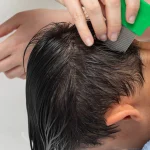
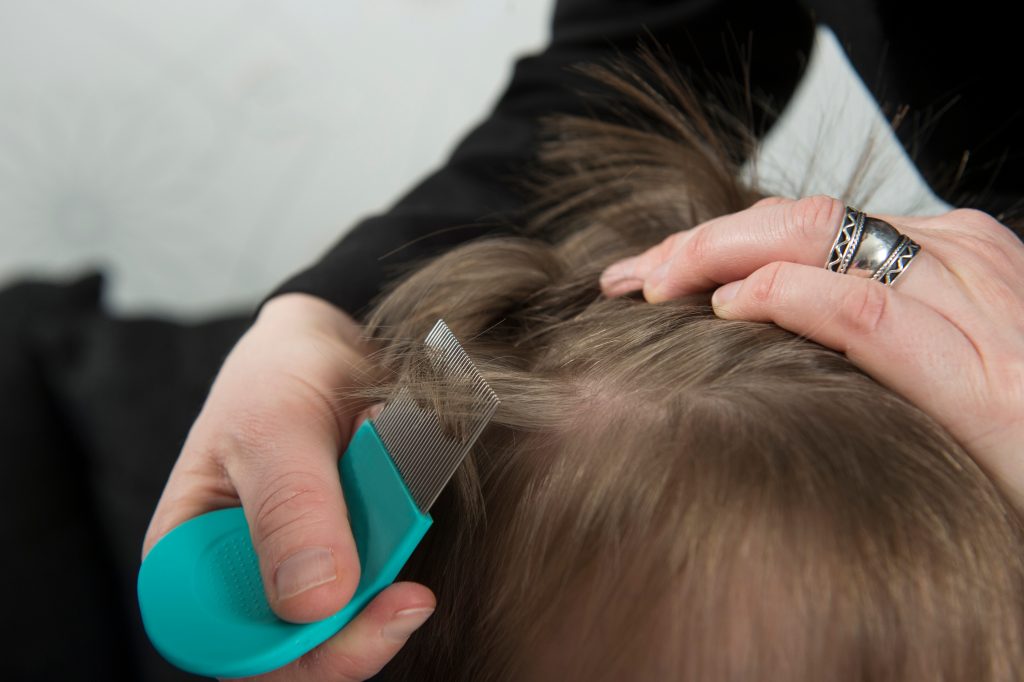
To check your child’s hair for lice, seat them in a brightly lit room, part the hair, and look at the scalp one small section at a time with a fine-tooth comb. Live lice stay on the scalp and avoid light; nits are glued to hair close to it, so start behind the ears and at the hairline at the back of the neck. The CDC counts finding a live nymph or adult louse as the best way to diagnose head lice, so a crawling insect is what you are looking for.
Live Louse, Nit or Dandruff: Telling the Three Apart
Three things turn up during a check, and only two of them are lice: a crawling louse, an egg glued to a single hair, and ordinary debris that imitates both. Learning the difference is the whole job. The CDC puts the stakes plainly: misdiagnosis of head lice infestation is common.
An adult louse is roughly 2 to 3 mm long, about the size of a sesame seed, according to the CDC’s page on head lice. Its body is usually pale and gray, says the AAP’s guidance for parents, though the color may vary, so do not wait for an obviously dark insect before you believe your eyes. Head lice are crawling insects. They cannot jump, hop or fly. They also move quickly and avoid light, which is part of why the CDC says they may be difficult to find.
A nymph is a young louse. The AAP describes it as looking like an adult head louse but much smaller, about the size of a pinhead, or 1.5 mm. The CDC says nymphs take about seven days to mature into adult lice. Nymphs and adults both feed on blood from the scalp, which is where they live, and the CDC notes lice can also be found on the eyebrows and eyelashes.
A nit is an egg, and it behaves nothing like the insect. The AAP describes nits as oval, about 0.8 mm long and 0.3 mm wide, roughly the size of a knot in thread, and yellow to white. Lice lay and attach their eggs to hair close to the scalp; the AAP says eggs are usually found within 4 to 6 mm of it and do not survive farther away. On the strand they read as small white or yellow-brown specks, and some blend in with a child’s own hair color.
Attachment is the test that settles it. Nits are held to the hair by a sticky substance that keeps them firmly in place, while dandruff, dirt particles and hair spray droplets are not firmly attached. If the speck slides along the strand or lifts away under a fingernail, it is not a nit. If it stays fixed to one hair near the scalp, count it as a nit and keep looking for something alive. If dandruff is what keeps you second-guessing, our post on how to tell lice from dandruff in your child’s hair works through the same comparison, and a separate one sorts out fleas or lice when there is a pet in the house.
| What you found | Size | How it looks | Where on the head | Does it move? |
|---|---|---|---|---|
| Adult louse | About 2 to 3 mm, the size of a sesame seed | Body usually pale and gray; color may vary | On the scalp; also the eyebrows and eyelashes | Yes. Crawls quickly and avoids light; cannot jump, hop or fly |
| Nymph (young louse) | About the size of a pinhead, 1.5 mm | Looks like an adult louse but much smaller | On the scalp | Yes. Very small, moves quickly, avoids light |
| Nit (egg) | 0.8 mm long and 0.3 mm wide, the size of a knot in thread | Oval; small white or yellow-brown specks; may blend with hair color | Attached to hair within a quarter inch of the base of the shaft | No. Held firmly in place by a sticky substance |
| Dandruff, dirt or hair spray droplets | Varies | Confused with nits by eye | Not tied to one spot on the shaft | Not firmly attached to the shaft |
The Comb-Out Check, Step by Step
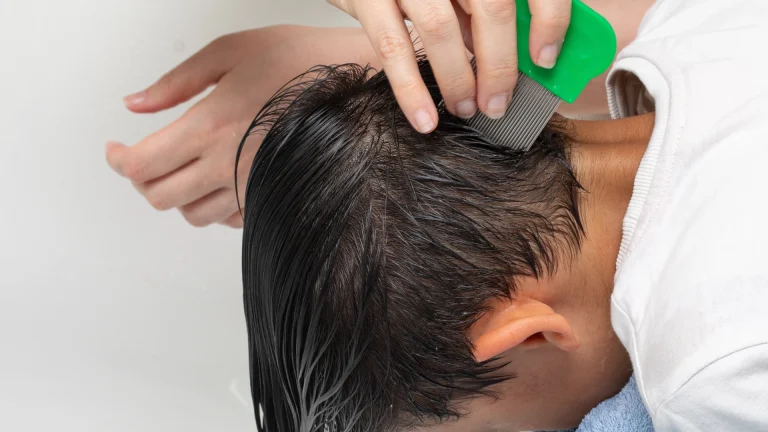
The AAP describes the check as four repeated steps with a fine-tooth comb, and the CDC agrees that a fine-toothed louse comb may help you find lice. Work in a brightly lit room, part the hair, and look at the scalp a section at a time. These are the AAP’s steps, in its order:
- Wet your child’s hair.
- Use a fine-tooth comb, a louse or nit comb, and comb through the hair in small sections.
- After each comb-through, wipe the comb on a wet paper towel, then examine the scalp, the comb and the paper towel carefully.
- Repeat the combing and wiping until you have combed through all of your child’s hair.
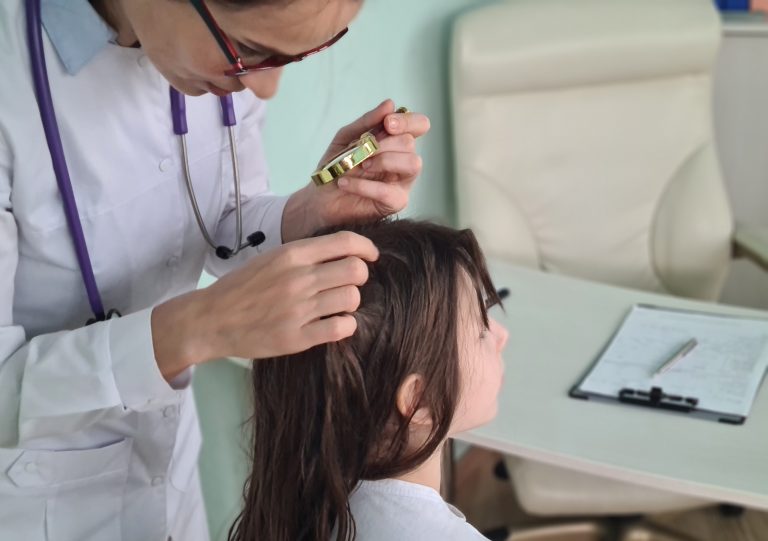
You can also look without wetting the hair. Seat your child in a brightly lit room, part the hair, and look for crawling lice and for nits a section at a time; MedlinePlus adds that it helps to part the hair all the way down to the scalp in very small sections. Head lice and nits can be visible with the naked eye, the CDC says, but a magnifying lens may help you find crawling lice or nits.
The kit is short: a fine-toothed comb, good light, and a lens if you have one. The CDC adds that flea combs made for cats and dogs are also effective, which is worth knowing if one is already in a drawer. Nothing from the medicine cabinet belongs in a check. A check is looking, not treating.
Where you start matters more than how fast you go. The AAP says the easiest place to find them is at the hairline at the back of the neck or behind the ears, and the CDC says you will often see nits on hair behind the ears and near the back of the neck. Those two zones deserve your first and most careful minutes. Give the eyebrows and eyelashes a look as well.
Wet hair or dry hair is a fair question, and it changes what the comb can do for you; our post on whether to check for lice on wet or dry hair takes that decision on its own. Either way the finish line is the same: every section combed through and examined, not a quick fluff through the top layer.
If you reach the end and still cannot call it, that is a normal place to land. Lice avoid light and move quickly, nits can disappear into hair color, and the CDC’s advice for this exact moment is short: if you are not sure if a person has head lice, see your healthcare provider.
How Soon After Contact Would a Check Show Anything?
Not immediately, which is worth knowing before you read anything into a calm, non-itchy child. The CDC says it may take four to six weeks for itching to appear the first time a person has head lice, and that people with head lice may not have symptoms, particularly with a first infestation or when an infestation is light. Comfort is not a clear result.
The eggs run on their own clock. The AAP says eggs hatch in 7 to 12 days depending on the surrounding temperature; the CDC puts the range at 6 to 9 days. After that, the AAP says nymphs become adults about 9 to 12 days after hatching, and that it takes only about 12 to 14 days for newly hatched eggs to reach adulthood. An adult female can lay up to 10 eggs a day by the AAP’s count, and the CDC’s figure is about six a day.
Left alone, the AAP says the cycle can repeat every 3 weeks. That is the argument for a second and a third look rather than one verdict, and the AAP calls regular checks a good way to spot head lice before they have time to multiply. The AAP says head lice live about 28 days; the CDC says adult lice can live on a person’s head for about 30 days. A single missed egg has room to grow into a larger problem than it was on the night you first looked.
Contact is the thing to think about, not housekeeping. The main way head lice spread is close, prolonged head-to-head contact, the AAP says, and the CDC names head-to-head contact as the most common way to get head lice. MedlinePlus notes that children ages 3 to 11 and their families get head lice most often, because young children often have head-to-head contact while playing together. Getting head lice is not related to cleanliness of you or your environment, the CDC says.
If you know about a specific contact, the timing above tells you when to look again. Our posts on how a child catches head lice and on what to do if your child was exposed to lice cover those situations in more detail. A check that finds nothing after a known contact is still a useful check; it sets the date you start counting from.
What the CDC and AAP Say To Do After a Positive Check
Call your child’s doctor before you start any treatment, and have the rest of the household checked. The AAP is explicit on the first half: check with your child’s doctor before beginning any head lice treatment, and head lice medicine should be used only when it is certain that your child has living head lice.
The second half is about everyone else under the same roof. The CDC says to check all household members and other close contacts for head lice, and to treat all infested people, plus anyone they share a bed with, at the same time. A household treated in shifts is a household where lice have somewhere to wait.
Old nits are not an emergency. If you see no nymphs or adults and the only nits you find sit more than a quarter inch from the scalp, the CDC says the infestation is probably old and does not need treatment; nits attached farther than that from the base of the hair shaft are almost always hatched or dead. Nits can also stay in the hair after a treatment that worked.
On treatment itself, defer to the label and your child’s doctor. The CDC’s treatment page says head lice can be treated with over-the-counter or prescription medications, that they are generally safe and effective when used correctly, and that you should follow all provided instructions. Some kill lice and eggs, and the CDC says retreatment is usually not required for those; others kill lice but not eggs, so a second treatment is recommended. The AAP adds that over-the-counter treatments sometimes are not the most effective, that lice can be resistant to their active ingredients in some communities, and that the likelihood of resistance varies across the country.
Both organizations are equally clear about what to keep out of this:
- Home remedies such as petroleum jelly, mayonnaise, tub margarine, essential oils or olive oil. The AAP says no studies prove they work, and the CDC says there is no scientific evidence that suffocating head lice with such substances is an effective form of treatment.
- Kerosene, gasoline, and medicines made for use on animals. The AAP says never to use them, and MedlinePlus calls kerosene and gasoline dangerous and flammable.
- Pesticide sprays in the home. The AAP says do not spray them, and the CDC says fumigant sprays and fogs are not necessary and can be toxic if inhaled or absorbed through the skin.
- Anything plastic on a child’s head. The AAP says never to place a plastic bag there.
After a treatment, the checking does not stop. The CDC says to check the hair and remove nits and lice every 2 to 3 days for the next 2 to 3 weeks. If a second opinion would settle this faster than another evening of squinting, you can book a head check and have the household looked at together.
Frequently Asked Questions
What do lice egg shells look like after they hatch?
They look like the same small specks, still cemented to the strand. The AAP says that after the eggs hatch, the empty nits stay on the hair shaft, held by the sticky substance that fixed them there. Distance from the scalp is the clue to their age: the CDC says nits attached more than a quarter inch from the base of the hair shaft are almost always hatched or dead.
Can you see lice and nits without a magnifying glass?
Yes, a lens is optional. Both can be seen with the naked eye, the CDC says; a lens only makes them easier to pick out. MedlinePlus pairs that lens with a fine-toothed comb for the same purpose. Light does as much work as magnification here, which is why the AAP’s instructions open with a brightly lit room rather than a gadget.
Does finding one nit mean my child has lice?
It depends on where it sits. A diagnosis of head lice usually comes from seeing a louse or a nit, MedlinePlus says, while the CDC treats finding a live nymph or adult louse on the scalp or hair as the best way to diagnose an infestation. When you see no crawling lice, the CDC says to look for nits attached firmly within a quarter inch of the base of the hair shafts, and to ask your healthcare provider if you remain unsure.
Should the whole family be checked if one child has lice?
Yes. The CDC says all household members and other close contacts should be checked for head lice, and MedlinePlus says the same. Timing matters as well: the CDC says to treat all infested people, and those they share a bed with, at the same time. Scrubbing the house is not the priority, and the CDC says spending much time and money on housecleaning is not necessary to avoid reinfestation.
Where do I look if my child’s hair is very short?
At the scalp, exactly as you would on long hair. Lice live on the scalp and attach their eggs to hair close to it, within 4 to 6 mm by the AAP’s measure, so length is not where the check happens. Begin behind the ears and along the hairline at the back of the neck. Whether cutting your child’s hair short changes anything is a separate question with its own answer.
Can my child have lice and no itching?
Yes. The CDC says people with head lice may not have symptoms, particularly with a first infestation or when an infestation is light, and that the itching is an allergic reaction to louse bites rather than the insects themselves. The AAP notes the reverse case too: itching caused by head lice can last for weeks, even after the lice are gone. Scratching is a reason to look, not a result.
Could it have come from the pet, the couch or the carpet?
Not from the pet. Animals do not get or spread head lice, the CDC says. Furniture is a small risk rather than a likely one: the CDC says the risk of getting lice from a louse that has fallen onto a rug, carpet or furniture is very small, and that lice will die within two days if they fall off a person and cannot feed. Check heads before you strip the living room.
How Lice Lifters of Chester County Can Help
A check you have run three times and still cannot call is a reasonable thing to hand to someone else. At Lice Lifters of Chester County we check the whole family in one appointment, so you are not deciding on your own who looks suspicious and who does not. If we find lice, we give a non-toxic treatment in one visit, and same-day appointments are available when waiting is the worst option. Our 30 Day Guarantee applies when the whole family is checked. You can see what a visit involves on our professional lice treatment page, and when you want the question closed, book a head check. There is no lecture attached and nothing to be embarrassed about. A clear answer is simply easier to act on than a maybe.