
Lice live on the scalp, not in the hair you add to it, so the risk follows whatever stays against your skin. The CDC says contracting lice from a wig or hairpiece is extremely unlikely, and clip-ins come off the same way. A sew-in, tape-ins or bonded extensions stay on day and night, over the scalp and roots where lice feed and lay eggs. That doesn’t make an install attract lice, but it does make the scalp beneath it harder to check.
What the CDC Says About Wigs and Hairpieces
A wig is a low-risk item. The CDC adds a condition worth noticing: the risk is lowest when the wig or hairpiece hasn’t been worn in the past 48 hours by a person with head lice. That matters for wigs that are shared or tried on, because the concern is recent contact with someone who has lice, not the wig on its own.
The reason comes down to food. Head lice are parasitic insects that feed on human blood, and a wig has none to give. According to the CDC, lice die within two days if they fall off a person and cannot feed, and the American Academy of Pediatrics (AAP) says they can’t survive more than one day without a blood meal. A louse stranded on a wig cap or a clip-in weft has little time left.
None of this protects the person under the wig. The CDC says head lice mainly spread by direct contact with the hair of a person who has them, and the AAP describes the main route as close, prolonged head-to-head contact. If anyone in the house has lice, the wearer’s own scalp still needs a check.
Why Lice Stay Within a Few Millimeters of the Skin
The louse life cycle plays out right next to the scalp. The AAP says lice lay and attach their eggs to hair close to the scalp, and that eggs “are usually found within 4 to 6 mm of the scalp and do not survive if they are farther away.” The CDC adds that eggs “cannot hatch and usually die within a week if they are not kept at the same temperature as those found close to the scalp.”
That is why the length of an extension, whether synthetic or human hair, is not where an infestation takes hold. Fibers hanging past the shoulders are far from the warmth and blood supply lice depend on. The hair that counts is the short stretch at the roots. The CDC gives a simple marker: nits attached more than a quarter inch from the base of the hair shaft are almost always hatched or dead. Our post on what a quarter inch of hair tells you about active lice explains how to use that line.
Sew-Ins, Tape-Ins and Bonds Sit Where Lice Live
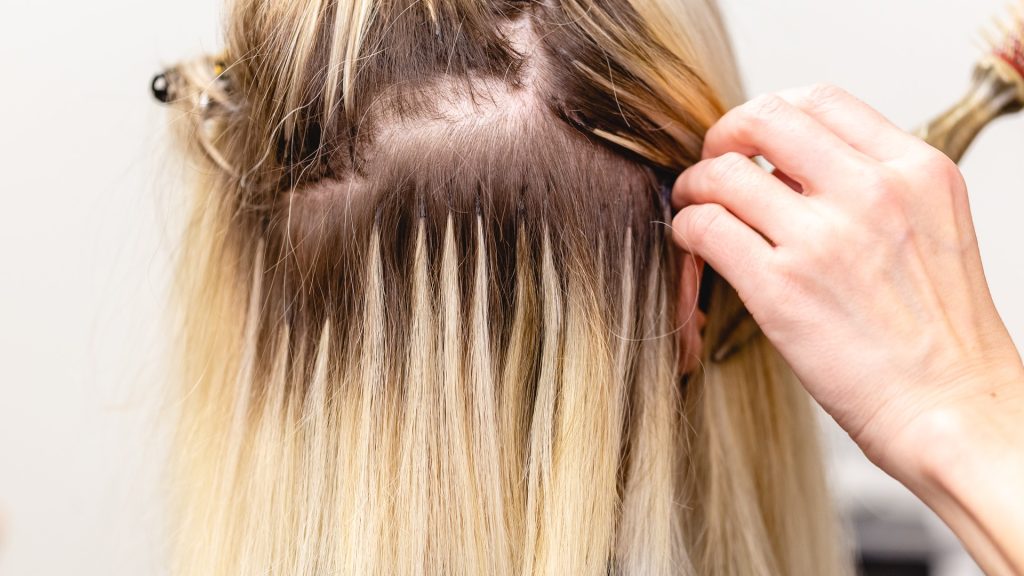
An install that stays in doesn’t draw lice to it, but it covers the same ground they use. A sew-in is built on braids that lie flat against the scalp, and tape-ins and bonds attach close to the roots. Your scalp is still under there and your own hair still grows from it, so lice that reach your head can feed and lay eggs as they would without the install.
The challenge is seeing them. Live lice are hard to find, the AAP notes, because they avoid light and move quickly. Tracks, braids and tape panels add layers between you and the skin you need to look at, and the part lines are fixed by the install rather than chosen by you. A check simply takes more patience.
Wash schedules make no difference. The CDC says getting head lice is not related to cleanliness of you or your environment, so stretching the time between washes does not invite lice, and extra washing does not keep them away. Our post on whether lice prefer clean or dirty hair covers that question further.
How to Check for Lice With Extensions In
A check with extensions in follows the same guidance as any head check, with extra time at the roots. MedlinePlus advises parting the hair all the way down to the scalp in very small sections. The AAP suggests a brightly lit room and a fine-tooth louse or nit comb, working section by section, and says the easiest places to find lice are the hairline at the back of the neck and behind the ears.
Know what a nit looks like. The AAP describes lice eggs as oval, about the size of a knot in thread and yellow to white. Styled hair adds a complication, since nits can be confused with dandruff, dirt particles or hair spray droplets. The AAP’s test is simple: nits are firmly attached to hair, while those other particles are not.
A nit by itself doesn’t settle the question. The CDC calls finding a live nymph or adult louse on the scalp or hair the best way to diagnose head lice, and notes that “misdiagnosis of head lice infestation is common.” If you aren’t sure, the CDC advises seeing your healthcare provider. Our guide to checking your child’s hair for lice walks through a full check step by step.
Lice Medicine When You Wear Added Hair
The label and your doctor guide this part, not the install. The CDC says to use lice medicine as directed on the box or label, and the AAP advises checking with your child’s doctor before beginning any head lice treatment. Mention the weave, tape-ins or extensions when you ask, so the advice fits the hair actually on the head.
A few points in the guidance matter for long or styled hair. The CDC notes that shoulder-length hair or longer might need a second bottle. It also says not to use a combination shampoo and conditioner, or conditioner, before using lice medicine, which is worth knowing if your routine includes conditioning products for extensions. Both sources tie medicine to live lice: the CDC says to treat when there is an active infestation, and the AAP says medicine should be used only when it is certain there are living head lice.
Whether an install should come out is a separate decision, and it turns on access. After each treatment, the CDC says to check hair and remove nits and lice every 2 to 3 days for the next 2 to 3 weeks. If the install keeps you from reaching the scalp in small sections across that stretch, talk it through with your child’s doctor and the stylist who placed it. Once the lice are gone, our post on caring for hair after lice treatment covers the weeks that follow.
Caring for Wigs, Clip-Ins and Combs
Pieces that come off your head fall under the same household guidance the CDC and AAP give for anything worn on the head. Check the care instructions for each wig or clip-in before using hot water or a hot dryer on it.
| Item | What the guidance says | Source |
|---|---|---|
| Wig or hairpiece | Contracting lice from one is extremely unlikely, especially if it hasn’t been worn in the past 48 hours by a person with head lice | CDC |
| Items you can wash | Machine wash and dry items used in the two days before treatment, with hot water (130 degrees Fahrenheit) and high heat drying | CDC |
| Items you can’t wash | Seal them in a plastic bag for two weeks, or dry-clean them | CDC and AAP |
| Combs and brushes | Soak in hot water (at least 130 degrees Fahrenheit) for 5 to 10 minutes | CDC |
| Throwing things out | You do not need to throw these items away | AAP |
| Sprays and fogs | Not necessary to control head lice, and can be toxic if inhaled or absorbed through the skin | CDC |
Two cautions sit alongside the table. If you bag a piece, keep the AAP’s warning in mind: never place a plastic bag on a child’s head. And keep wigs, clip-ins and the brushes used on them personal, since the CDC advises against sharing combs, brushes, towels, hats and hair ribbons.
Frequently Asked Questions
Can wigs get lice?
A wig can carry a stray louse for a short time, but it can’t keep one alive or let eggs develop. With no blood to feed on and none of the scalp’s warmth, a louse or egg on wig hair has no future, which fits the CDC’s view that catching lice from a wig is extremely unlikely. Hair-to-hair contact is how the wearer’s own scalp could still get them.
Can you get lice from hair extensions?
Catching lice from the extension hair itself is unlikely, since lice need a scalp to feed on and die within a day or two once off a person. An install that stays in does not shield your own scalp, though. Lice spread through close head-to-head contact, and the roots under a weave or tape-ins are where they would be found.
Can lice live on synthetic hair?
Synthetic hair can’t support lice for long. Lice survive by feeding on human blood, and their eggs need the temperature close to the scalp to hatch, so synthetic fibers give them neither food nor a nursery. The same is true of human-hair wigs and clip-ins once they are off the head. Any risk sits with the wearer’s own scalp, not the fibers.
How do you check for lice with tape-in extensions?
Look at the roots around each tape panel, where your own hair meets the scalp. That narrow band is where eggs get glued, so the hair right beside the panels deserves the closest look. Good light, small sections and a fine-tooth comb help, and a professional head check is an option when the panels make the view hard.
Do I need to remove my sew-in if someone in the house has lice?
Not just because someone else has lice. The CDC advises checking all household members and close contacts and treating anyone with an active infestation. Begin with a close look at your own roots and hairline. If lice turn up and the install makes the follow-up combing hard, raise it with your doctor and your stylist before deciding.
Does itching under my weave mean I have lice?
Not on its own. The CDC says “itching (pruritus) is the most common symptom of head lice infestation,” yet it may take four to six weeks to show up the first time, and people with a light infestation may have no symptoms. The AAP adds that itching can last for weeks after the lice are gone. Finding a live louse is what confirms an active case.
How Lice Lifters of Chester County Can Help
If a weave, tape-ins or a wig is making it hard to tell what’s going on, our clinic can help. Lice Lifters of Chester County checks the whole family, and if lice are found, we provide a non-toxic treatment in one visit. Same-day appointments are available when waiting feels like too much. Our 30 Day Guarantee applies when the whole family is checked. You can read more about our professional lice treatment first, or book a head check whenever you’re ready. Added hair doesn’t change the goal: a clear answer about what is happening on the scalp. Bring the questions you have about your install, and we’ll talk them through calmly.