

Head lice came from another person’s head, and that is as far back as the trail usefully goes. The CDC’s head lice guidance says the most common way to get head lice is head-to-head contact with someone who already has them. Lice are human parasites that feed on human blood, they crawl rather than jump or fly, and animals do not get or spread them. So a case starts on a scalp, travels hair to hair, and lands on a scalp.
Where a Louse Comes From Before It Reaches Your Child
A louse comes from another human scalp, because that is the only place it can live. The CDC describes head lice, or Pediculus humanus capitis, as parasitic insects that feed on human blood and live mainly on the head, though they can turn up in eyebrows and eyelashes too. MedlinePlus puts the dependency plainly: they need to feed on human blood to survive. Off a person and unable to feed, the CDC says, they will die within two days.
That rules out the sources parents reach for first. Pets are not one: the CDC says animals do not get or spread head lice. Furniture is not one either, since the CDC calls the risk of picking up lice from a louse that has fallen onto a rug, carpet or furniture very small, which is worth knowing before anyone starts hauling cushions outside.
Inside one household, then, the colony has a traceable start: a louse that walked over from someone else’s head and began laying. The CDC says an adult female can lay about six eggs each day, and the AAP’s guidance for parents says lice attach those eggs to hair close to the scalp with a sticky substance that holds them firmly in place. The AAP adds that eggs are usually found within 4 to 6 mm of the scalp and do not survive farther away, which is why the CDC treats nits more than 1/4 inch from the base of the hair shaft as almost always hatched or dead.
If you were asking the longer version of the question, about where this insect came from before it ever met a person, that is not what the CDC, the AAP or MedlinePlus set out to settle. They answer the narrower question, and it is the one that matters in a house with lice in it: a case comes from contact with a person who has them.
What Has To Happen for Lice To Reach a New Head
Head-to-head contact is what moves lice, and it does not take long. The CDC names direct contact with the hair of a person who has lice as the main route, and says this contact can be common among children playing at home and in other everyday places. Head lice move by crawling. They cannot hop or fly, so there is no leap across a car seat and no drift through the air: two heads touch, or something that has been on one head reaches another.
The CDC does list other routes, while labeling them less common:
- Wearing a hat, scarf, coat, sports uniform or hair ribbon worn by a person who has lice.
- Using an infested comb, brush or towel.
- Lying on a bed, couch, pillow, carpet or stuffed animal that has recently been in contact with an infested person.
The AAP puts the odds on those routes plainly: there is a very small chance that head lice will spread by sharing items such as combs, brushes, hats and sports helmets. MedlinePlus calls it rare.
Prevention follows from the route. The CDC’s advice is to avoid hair-to-hair contact during play and other activities, including at a playground, at sports activities, at slumber parties and at camp, and to teach children not to share hats, scarves, coats, sports uniforms, hair ribbons, barrettes, combs, brushes or towels. MedlinePlus extends the list to anything else that goes on the head, such as headphones, hair ties and helmets. None of that makes a household lice-proof; it lowers the number of chances.
You may never identify the source. The CDC says people with head lice may not have symptoms, particularly with a first or light infestation, so whoever passed it along may not know they have it.
Why a Lice Case Is Not a Verdict on Your Housekeeping
Getting head lice is not related to cleanliness of you or your environment. That is the CDC’s own sentence, and MedlinePlus says the same thing from the other direction: personal hygiene and cleanliness have nothing to do with getting head lice. The AAP is specific about hair, noting that lice can attach to the hair of anyone’s head whether that hair is clean or dirty, and that anyone can get head lice.
The numbers make the point less personal. The CDC puts an estimated 6 to 12 million infestations each year in the United States among children 3 to 11 years of age, and MedlinePlus says children ages 3 to 11 and their families get head lice most often. MedlinePlus explains the age pattern the same way the CDC does: young children have head-to-head contact while playing together. It is a contact pattern, not a character pattern.
The health stakes are lower than the fear suggests, too. The AAP says head lice do not put a child at risk for any serious health problems and carry no diseases, describing them as a nuisance. The complication the CDC and MedlinePlus do flag is secondary: sores from scratching, which can sometimes become infected with bacteria normally found on the skin.
So the question worth asking is not what you did wrong. It is what is on your child’s head right now.
Why the Case Was Already Underway When You Found It
Lice arrive quietly, and the delay is biological rather than parental. The CDC says it may take four to six weeks for itching to appear the first time a person has head lice, because the itch is an allergic reaction to louse bites; the AAP describes the same lag as the time before the scalp becomes sensitive to lice saliva. Itching is the most common symptom when it does arrive, and the AAP says most of it happens behind the ears or at the back of the neck.
The other symptoms are easy to read as something else. The CDC lists a tickling feeling or a sensation of something moving in the hair, plus irritability and sleeplessness. MedlinePlus explains the sleep problem by noting that head lice are most active in the dark, which is worth knowing if you have wondered whether head lice really come out at night.
Then there is the matter of size. The CDC says adult and nymph lice are very small, move quickly and avoid light, so they may be difficult to find, and the AAP agrees that live lice are hard to find.
Here is what you are looking for, stage by stage, in the sources’ own measurements:
| Stage | What you would see | Timing |
|---|---|---|
| Egg (nit) | Oval, about the size of a knot in thread, 0.8 mm long and 0.3 mm wide, usually yellow to white, firmly attached to hair near the scalp | Hatches about a week after it is laid, a range of 6 to 9 days |
| Nymph | Like an adult louse but much smaller, about the size of a pinhead | Takes about seven days to mature into an adult |
| Adult louse | Roughly 2 to 3 mm long, about the size of a sesame seed; bodies usually pale and gray, though color can vary | Lives on a person’s head for about 30 days |
A case found late looks worse than a case found early, which is why the AAP recommends regular checks as a way to spot head lice before they have time to multiply.
What the CDC and the AAP Say To Do Once You Find Lice
Confirm a live louse, check every head in the household, and talk to your child’s doctor before any medicine goes on a scalp. The CDC says finding a live nymph or adult louse on the scalp or hair is the best way to diagnose an infestation, and that misdiagnosis of head lice is common. Nits are confused with dandruff, hair spray droplets and dirt particles; the AAP’s test is that nits are firmly attached to hair while those other things are not.
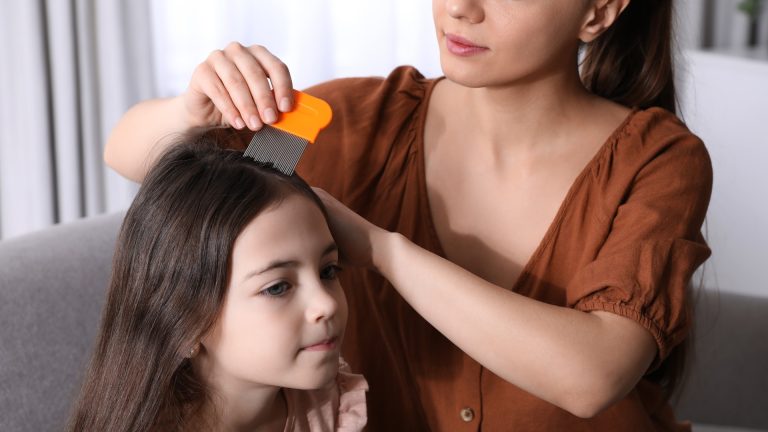
The AAP’s comb-out check runs in four steps, done in a brightly lit room: wet the hair; comb it in small sections with a fine-tooth louse or nit comb; wipe the comb on a wet paper towel after each pass and examine the scalp, comb and towel; then repeat until all of the hair has been combed. The AAP says the easiest places to find lice are the hairline at the back of the neck and behind the ears, and the CDC says you will often see nits in those same spots, within 1/4 inch of the base of the hair shafts. The AAP also notes that the comb-out method usually does not work on its own to get rid of head lice.
Everyone gets checked, not just the child who itched. The CDC says to check all household members and other close contacts, and to treat everyone who is infested, including people they share a bed with, at the same time. On medicine, the AAP says head lice medicine is the most effective treatment, that you should check with your child’s doctor before beginning any of it, and that it should be used only when it is certain the child has living head lice. The CDC’s treatment guidance says both over-the-counter and prescription products are available and are generally safe and effective when used correctly.
The sources are equally clear about what not to do:
- The AAP says to skip home remedies such as petroleum jelly, mayonnaise, tub margarine, essential oils and olive oil, because no studies prove they work; the CDC says there is no scientific evidence that suffocating lice this way is effective.
- Never use gasoline or kerosene, or medicines made for animals. The AAP calls them dangerous, and they are flammable.
- Do not place anything made of plastic on a child’s head. The AAP calls that dangerous.
- Do not spray pesticides in the home or use fumigant sprays and fogs. The CDC says they are not necessary and can be toxic if inhaled or absorbed through the skin.
- The AAP says an adult should apply any medicine, never the child, and that no child should be left alone with medicine in their hair.
Housecleaning is a smaller job than it feels like. The CDC says to machine wash and dry the clothing, towels and bed linens used in the two days before treatment, using hot water at 130 degrees Fahrenheit and high heat drying; to seal what cannot be washed or dry cleaned in a plastic bag for two weeks; to soak combs and brushes in hot water of at least 130 degrees Fahrenheit for 5 to 10 minutes; and to vacuum where the infested person sat or lay. It adds that spending much time and money on housecleaning is not necessary to avoid reinfestation.
If live lice are still crawling days later, the sources point back to the doctor rather than to a bigger dose. The CDC lists the reasons treatment fails, among them misdiagnosis, not following the instructions, lice resisting the medication and reinfestation, and says to talk to a healthcare provider before re-treating. The AAP says head lice can be resistant to the active ingredients in over-the-counter treatments in some communities. Both also say to keep combing: remove nits and lice every 2 to 3 days for 2 to 3 weeks after treatment.
Frequently Asked Questions
Where did lice come from originally?
From another person’s head. The CDC identifies head lice as parasitic insects, Pediculus humanus capitis, that feed on human blood, and MedlinePlus says they need human blood to survive. Because a louse cannot live anywhere else for long, the origin of a case is a human carrier rather than a place, a season or a date on a calendar.
Where do lice come from before humans?
Nowhere you can act on, and nowhere the public health sources point. Head lice are described as human parasites: they live on the scalp, feed on human blood, and the CDC says they will not survive long once they fall off a person and cannot feed. There is no animal host to treat, and the CDC calls the risk from a louse that has fallen onto furniture very small, so the search ends at another person.
How does lice start in the first place?
It starts with one or more live lice crawling onto a head during contact with someone who has them. From there, the CDC describes a cycle: eggs glued to hair close to the scalp, nymphs hatching about a week later, and nymphs maturing into adults in about another seven days. A case found today began before today.
Can my child catch head lice from the dog or the cat?
No. Animals do not get or spread head lice, according to the CDC, so pets need no treatment, no bath and no banishment from the bedroom. Head lice feed on human blood and live on human scalps. If a case keeps coming back, look at the human heads in and around the household instead.
Can head lice spread in a swimming pool?
It is unlikely, according to the CDC, which says head lice can survive under water for several hours but are unlikely to spread in a swimming pool. The CDC also notes that chlorine levels in pool water do not kill head lice. Shared towels are the thing to watch at the pool, since the CDC advises against sharing combs, brushes and towels.
Are head lice dangerous?
No. The CDC says head lice do not transmit any disease and are therefore not considered a health hazard. They are uncomfortable and they spread, which is reason enough to treat a case, but they are not a medical emergency. One thing to expect: the AAP says itching caused by head lice can last for weeks even after the lice are gone.
How Lice Lifters of Chester County Can Help
Finding the first louse is not a verdict on your household, and you do not have to work a 2 to 3 week comb-out calendar alone. At Lice Lifters of Chester County we check every head in the family, because one missed case starts the cycle over. Our professional lice treatment is non-toxic and finishes in one visit, and same-day appointments are available. Our 30 Day Guarantee applies when the whole family is checked. If you would rather not spend the week doing this yourself, book a head check for the whole household.