

No, swimming does not get rid of head lice, and the chlorine in a pool will not kill them. The CDC says chlorine levels in pool water do not kill head lice, and that lice can survive under water for several hours but are unlikely to spread in a swimming pool. That several-hours finding is about water in general, so a lake or the ocean is no treatment either. The risk at a pool or a lake sits in head-to-head contact and shared gear, not in the water.
What Chlorine Does and Does Not Do to Head Lice
Chlorine does not kill head lice at the levels pool water carries. That is the CDC’s plain statement, and a longer swim does not change it, because the same guidance says head lice can survive under water for several hours. Head lice are parasitic insects that feed on human blood. Water is not a weapon against them, and a pool is not a decontamination step.
What does work is treatment, and the CDC’s treatment guidance is specific about it. An active infestation is treated with a medication, either over the counter or by prescription, used as directed on the box or label. The CDC also says the best way to diagnose an infestation is finding a live nymph or adult louse on the scalp or hair. A swim is neither a diagnosis nor a treatment, and treating without one of those findings puts the medicine before the evidence.
Cleanliness is not the variable here, which is worth saying out loud at a pool. The CDC says getting head lice is not related to cleanliness of you or your environment. A well-kept pool, a fresh towel and a child who rinses off after every swim do not add up to protection, and a child who picks up lice has not done anything wrong.
Can Head Lice Pass From Swimmer to Swimmer in the Water?
Spread in the water itself is unlikely, and the CDC says so directly. The mechanism is simple: head lice move by crawling, and they cannot hop or fly. A louse travels when hair touches hair, which is why the CDC names direct contact with the hair of a person who has lice as the main route, and head-to-head contact as the most common way to get them.
At a pool, the contact worth watching is hair touching hair. Two kids squeezed onto one float, a huddle for a photo, a rest side by side after lunch: that is the contact the CDC asks families to avoid during play and other activities, and it names sports activities, playgrounds, slumber parties and camp as the settings where it happens. The CDC also advises against lying on beds, couches, pillows, carpets or stuffed animals that have recently been in contact with a person who has head lice.
None of that calls for policing a pool deck. It argues for one habit that is easy to keep: each child’s towel, comb and hat stay with that child. For a closer look at the water itself, read can you get lice from a swimming pool.
If a Pool Will Not Do It, Will a Lake or the Ocean?
The water does not do the work. The CDC’s statement about chlorine in pool water is no, and its line that head lice can survive under water for several hours is about water in general. What the CDC and AAP describe for treatment is narrow: a lice medicine used as directed, together with checking and combing.
If the next idea is a kitchen remedy, the agencies are blunt. The AAP says not to use home remedies such as petroleum jelly, mayonnaise, tub margarine, essential oils or olive oil, because no studies prove they work. The CDC says it does not have scientific evidence that suffocating head lice with mayonnaise, olive oil, margarine, butter or similar substances is an effective form of treatment. A day in the lake is a day out, not a treatment.
What is worth planning for is the trip around the water. A day at a lake has the same ingredients as a day at a pool, which is close contact and a shared pile of towels and hats on a blanket. If lice have already turned up in your household, the gear that comes home matters more than the swim did.
Towels, Caps, and Hair Ties: The Pool Bag Decisions That Matter
Sharing what touches a head is the part of a pool day worth changing. The CDC sorts the routes clearly: head-to-head contact is how head lice mainly spread, and items worn or used on the head sit on its less common list. Its advice for that second list is short.
- Do not share combs, brushes or towels.
- Do not share clothing such as hats, scarves, coats, sports uniforms, hair ribbons or barrettes.
- MedlinePlus adds the items a swim bag actually holds, teaching children not to share things they put on their head such as headphones, hair ties and helmets.
The AAP puts the size of that risk in proportion, saying there is a very small chance that head lice will spread by sharing items such as combs, brushes, hats and sports helmets. Small is not zero, and keeping one towel per bag costs nothing but a habit. Once lice have actually been found, the cleanup question has a narrower answer than a weekend deep clean.
| What came home from the water | What the CDC advises |
|---|---|
| Towels, swim clothing and other items worn or used in the two days before treatment | Machine wash and dry them, using the hot water (130 degrees Fahrenheit) laundry cycle and the high heat drying cycle |
| Combs and brushes used by the person who has lice | Soak them in hot water (at least 130 degrees Fahrenheit) for 5 to 10 minutes |
| A swim bag, a hat or anything you cannot wash or dry clean | Seal it in a plastic bag and store it for two weeks |
| Floors and furniture at home | Vacuum, particularly where the infested person sat or lay |
Swimming While a Lice Treatment Is Still Working
The timing rule to follow is the one printed on the product, not a rule about pools. The CDC says not to re-wash the hair for 1 to 2 days after the lice medicine is removed, and the AAP says not to shampoo for 24 to 48 hours afterward. A swim runs water through the hair the way a wash does, so it is a question for the product label and your child’s doctor, and the AAP says to check with that doctor before beginning any head lice treatment.
One after-swim habit is worth flagging before a treatment rather than after. If conditioner is part of your routine when chlorine comes out of the hair, keep it away from a treatment day: the CDC says not to use a combination shampoo and conditioner, or conditioner, before using lice medicine.
Treatment is also not a single afternoon. After each treatment, the CDC says to check the hair and remove nits and lice every 2 to 3 days for the next 2 to 3 weeks, and to check all household members and other close contacts. It says to talk to a healthcare provider before re-treating. Swim season changes none of that. It just means the comb-out happens after the rinse instead of before bed.
Frequently Asked Questions
Can head lice survive underwater?
Yes, for a while. The CDC says head lice can survive under water for several hours. Away from a person it is a different story: the CDC says lice that fall off and cannot feed will die within two days, and the AAP says they cannot survive more than one day without a blood meal. Either way, a submerged louse on a child’s head is still a live louse.
Does salt water kill head lice?
No. The CDC says head lice can survive under water for several hours, and that is a statement about water in general. The treatments the CDC and AAP describe are lice medicines used as directed, plus checking and combing, and the AAP says not to use home remedies because no studies prove they work. An ocean trip is a day out, not a treatment.
Do swim caps prevent head lice?
The prevention steps the CDC names are avoiding hair-to-hair contact during play and not sharing items worn on the head or used in hair. A cap your child owns and keeps fits those steps. A cap handed from swimmer to swimmer is the kind of shared head item the AAP says carries a small chance of spreading lice.
We found lice the morning of a pool day. Does the swim make it worse?
The CDC says head lice are unlikely to spread in a swimming pool and that chlorine does not kill them, so the swim will not treat it. Lice spread mainly by direct contact with the hair of a person who has them, so the parts of the day to manage are the shared float, the group photo and the towel pile. The AAP advises working quickly but safely to treat a child who has head lice so they do not spread.
How do I check my child’s head after a swim?
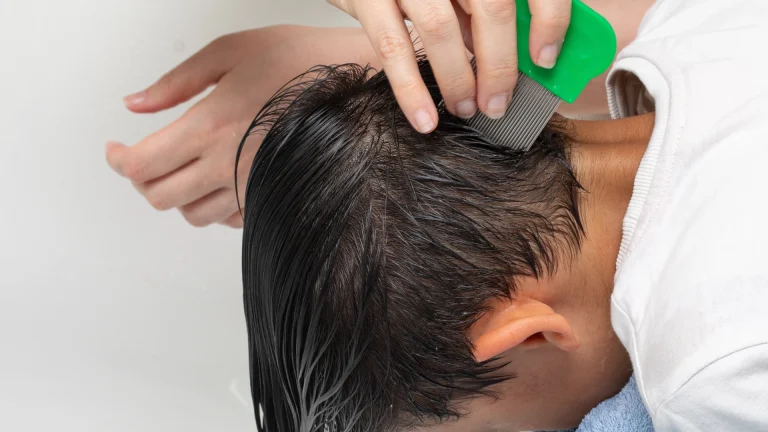
Comb wet hair in a bright room, section by section. The AAP’s method is to seat your child in a brightly lit room, part the hair, use a fine-tooth louse or nit comb through small sections, wipe the comb on a wet paper towel after each pass, and examine the scalp, comb and towel. The easiest place to find them is the hairline at the back of the neck or behind the ears.
My child’s scalp itches after swimming. Is that lice?
Not by itself. The CDC calls itching the most common symptom of head lice and says it is an allergic reaction to louse bites, but it also says itching may take four to six weeks to appear the first time, and that some people have no symptoms at all. The AAP adds that itching can last for weeks after the lice are gone. Finding a live louse is what settles it.
Does the pool itself need to be cleaned after someone with lice swims?
The CDC says head lice are unlikely to spread in a swimming pool, and its cleanup advice points at laundry, at soaking combs and brushes, and at vacuuming floors and furniture, and it says spending much time and money on housecleaning activities is not necessary to avoid reinfestation. It also says not to use fumigant sprays or fogs, which are not necessary to control head lice and can be toxic if inhaled or absorbed through the skin.
How Lice Lifters of Chester County Can Help
When a head check after a swim turns up something you cannot name, bring it to us. We check the whole family, which is what the CDC advises for household members and close contacts, and our professional lice treatment is non-toxic and done in one visit. Same-day appointments are available when you find something in the morning and want it handled that day. Our 30 Day Guarantee applies when the whole family is checked. If you have already treated at home and you are not sure it worked, that is a good reason to have someone look. Book a head check and we will take it from there.