
Fleas vs. lice is a question with a clear answer: they are two different insects, not the same bug. Head lice live on a human head and crawl; they cannot jump, hop or fly. Fleas feed on animal or human blood, prefer animal hosts, and have powerful hind legs built for jumping. Three checks sort it out fast: did it jump or did it crawl, is the trouble on the scalp or on the pet and the carpet, and are there oval specks stuck firmly to the hairs?
Below you’ll find a side-by-side comparison of the two insects, direct answers to whether fleas and lice are the same thing and whether fleas can turn into lice, what baby fleas actually look like, how to tell if fleas are in hair, and what to do next.
Fleas vs. Lice at a Glance
| What to check | Head louse | Flea |
|---|---|---|
| Where it lives | On a human head, feeding on human blood; an adult can live on a person’s head about 30 days | Adult fleas spend most of their time on the dog or cat; eggs and larvae end up in carpeting, beneath furniture cushions and in bedding |
| Size | 2 to 3 mm long, about the size of a sesame seed | Also small |
| Color and shape | Usually pale and gray, though the color may vary | Reddish-brown to black, wingless, flattened from side to side |
| How it moves | Crawls; cannot jump, hop or fly | Powerful hind legs for running and jumping through hair and fur |
| Its eggs | Oval nits held to a hair by a sticky substance, within 1/4 inch of the scalp; they hatch in about a week | Dry, smooth eggs that easily fall out of the animal’s hair into carpet and bedding |
| Its babies | Nymphs that look like adult lice but are the size of a pinhead; about seven days to mature | Wormlike larvae with no eyes and no legs, hidden beneath carpet fibers and furniture cushions |
| How it reaches a person | Mainly by direct contact with the hair of a person who has lice | Bitten when sharing space with a flea-infested animal; adults can also hitch a ride on a person’s shoes and pant legs |
| Bites and itch | Feeds on human blood; most of the itching happens behind the ears or at the back of the neck, and some people have no symptoms | Bites dogs and cats as well as people; bites often occur on the lower legs and feet |
Both are small, so size by itself will not settle fleas vs. lice. Shape, color, movement and where you found the bug do the real work.
Are Fleas and Lice the Same Thing?
No. Fleas and lice are two different insects. They get confused because both are small insects that feed on blood: the CDC describes head lice as parasitic insects that feed on human blood, and the same agency’s page on fleas calls fleas small insects that survive by feeding on animal or human blood. That is where the similarity stops.
Their homes are different. The CDC says animals do not get or spread head lice, while fleas prefer animal hosts but will resort to biting people when animals are unavailable. Their movement is different: a louse crawls, a flea jumps. Their eggs are different: a louse glues its eggs to hair, and flea eggs fall out of hair into the carpet. So when you are weighing lice vs. fleas, you are choosing between two separate problems with two separate fixes. One is handled on people’s heads, the other on the pet and in the house, which is why it pays to make sure it’s lice before you buy lice shampoo.
Can Fleas Turn Into Lice?
No. A flea never becomes a louse, and a louse never becomes a flea. Each insect runs its own life cycle from start to finish. A flea’s cycle has four stages, egg, larva, pupa and adult. A head louse has its own three stages: the nit, the nymph and the adult. The CDC says nits take about a week to hatch into nymphs, and those nymphs take about seven more days to mature into adult lice. If you want the stage-by-stage version, here is the head lice life cycle.
People ask the flip side too: can you get lice from fleas, or from the dog? The CDC says head lice mainly spread by direct contact with the hair of a person infested with lice, and that animals do not get or spread head lice. Neither the CDC nor the American Academy of Pediatrics lists fleas or pets as a way head lice spread.
What Do Baby Fleas Look Like?
Not like tiny adult fleas. A baby flea is a larva, which is wormlike, with no eyes and no legs. Those larvae remain hidden beneath carpet fibers, furniture cushions and other protected areas, including wherever the pet rests and sleeps, and they feed on organic debris in the floor covering, including flea dirt, the dried blood adult fleas leave behind. Then they spin silk cocoons and develop inside them.
That matters for the question you are actually asking, because a flea larva does not live on a person’s scalp. A baby louse is a different picture: the CDC says a nymph looks similar to an adult louse but is very small, the size of a pinhead, and the American Academy of Pediatrics describes the nymph as looking like an adult head louse, only much smaller. So a pale, pinhead-size bug crawling in scalp hair is a nymph question, not a flea larva question. It helps to know what a live louse looks like against a single strand of hair before you squint at a speck. And if the tiny pale insect turned up on a windowsill or in a book rather than in the hair, booklice vs. head lice is the comparison you want.
What Does Each Bug Look Like Up Close?
Do fleas and lice look the same? No, but they are close enough in size to cause a moment of doubt. A head louse is 2 to 3 mm long, about the size of a sesame seed, and the American Academy of Pediatrics describes its body as usually pale and gray, with color that may vary. A cat flea is reddish-brown to black, wingless, and laterally compressed, which means flattened from side to side rather than top to bottom. So flea vs. lice size is not the tell it sounds like.
Shape and color carry more weight. A louse is a pale insect you find traveling along a hair. A flea is darker and narrow from side to side, the body plan of an insect that moves through fur. Add movement and the picture firms up quickly: one crawls, the other is gone in a hop. If you can see the bug at all, judge it by shape, color and behavior rather than by a millimeter reading taken with your eye.
Where It Lives Is the Real Tell
Where the bug lives is the question that sorts this out, and it is something you can actually check. A head louse lives on a person’s head. The CDC says an adult louse can live on a person’s head for about 30 days but will die within two days if it falls off and cannot feed, and the American Academy of Pediatrics puts it at no more than 1 day without a blood meal. Either way, a louse off a head is on a short clock, so the head is where lice are.
Fleas run the other way. Adult fleas spend most of their time on the dog or cat, not in the carpet, and the eggs soon fall off into carpeting, beneath the cushions of furniture, and wherever else the pet rests or sleeps. The adult is the only stage in the cat flea life cycle when the fleas live on the pet, so the other stages are developing in your floors and furniture. The CDC adds that fleas prefer animal hosts but will resort to biting people when animals are unavailable, and fleas bite dogs and cats as well as people. A flea can bite a person; its life still runs through the pet and the house.
That is also why the two spread in completely different ways, and why the fix is different. Lice pass between people, which is why how head lice actually pass from one head to another looks nothing like a flea problem. You clear lice off the people. You clear fleas off the animal and out of the house.
The Eggs Settle the Question
Eggs are where this gets decided, because lice attach theirs and fleas do not. Lice eggs are called nits. They are oval, and the American Academy of Pediatrics says nits attach to the hair with a sticky substance that holds them firmly in place. The CDC tells you where to look: if you do not see crawling lice, look for nits attached firmly within 1/4 inch of the base of the hair shafts. Flea eggs do the opposite. Because of their dry, smooth surface, flea eggs easily fall out of the animal’s hair into carpeting and beneath furniture cushions. A flea egg is not built to stay put on a hair.
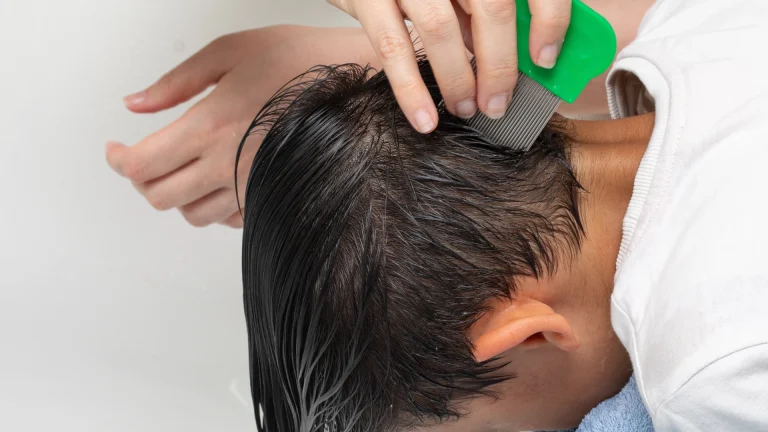
So test the speck instead of staring at it. The American Academy of Pediatrics gives the test in one line: nits are firmly attached to hair, while dandruff, dirt or other particles are not. The CDC adds that nits are often confused with other particles found in hair such as dandruff, hair spray droplets and dirt particles, so a wrong guess here is a common one. Those are the same clues you read on the pale specks that turn up on a lice comb, and position matters as well, which is the point of how a quarter inch of hair tells you whether lice are active.
Flea dirt is the other speck worth knowing. Flea dirt is blood expelled as feces, appearing as dark, pepper-like specks in the pet’s fur. It turns up on the animal, so that is where to look for it.
Did It Jump, or Did It Crawl?
Movement is a quick, honest test, and you do not need a magnifier for it. The CDC says head lice move by crawling and cannot hop or fly, and the American Academy of Pediatrics is blunter: head lice are crawling insects, and they cannot jump, hop, or fly. A louse scurries along the hair and grips when you reach for it. That grip is the behavior of an insect built to stay on a head.
A flea does the opposite. Powerful hind legs allow it to run and jump through hair, fur and feathers, enough to hitch a ride on a shoe or pant leg. If the bug vanished in a sudden hop off the comb or off your hand, you were looking at a flea.
Watch what the bug does before you try to judge its color. Jump or crawl takes two seconds, and it points you at the right problem: the person’s head, or the pet and the floors.
How Can You Tell If You Have Fleas in Your Hair?
Start with the honest version: a flea can bite a person. What it does not do is set up its life in a person’s hair. The adult flea lives on the pet, and the CDC says flea bites often occur on the lower legs and feet. The CDC also says the best way to prevent fleas on people is to keep pets free of fleas.
Signs that point to fleas: bugs that jump, bites on the lower legs and feet, a dog or cat that keeps scratching, and dark, pepper-like specks in the pet’s fur or where the pet sleeps.
Signs that point to lice: a crawling insect in the hair, or oval specks stuck firmly within about a quarter inch of the scalp. The American Academy of Pediatrics says most of the itching happens behind the ears or at the back of the neck. A quiet scalp does not clear it, though. The CDC says people with head lice may not have symptoms, particularly with a first infestation or when an infestation is light.
The CDC also says misdiagnosis of head lice infestation is common, that finding a live nymph or adult louse on the scalp or hair is the best way to diagnose it, and that if you are not sure, see your healthcare provider. It is a good reason to make sure it’s lice before you buy shampoo.
Match What You’re Seeing to the Right Answer
Here is how to map what you found onto what to do next.
- A crawling insect in the scalp hair, plus oval specks attached firmly within 1/4 inch of the scalp: treat it as lice. The CDC calls finding a live nymph or adult louse the best way to diagnose it, and the American Academy of Pediatrics says to check with your child’s doctor before beginning any head lice treatment.
- Bugs that jump, bites on the lower legs and feet, pepper-like specks in the pet’s fur, and a pet that will not stop scratching: point your effort at the animal and the house. The CDC says the best way to prevent fleas on people is to keep pets free of fleas, and a veterinarian can advise on the pet.
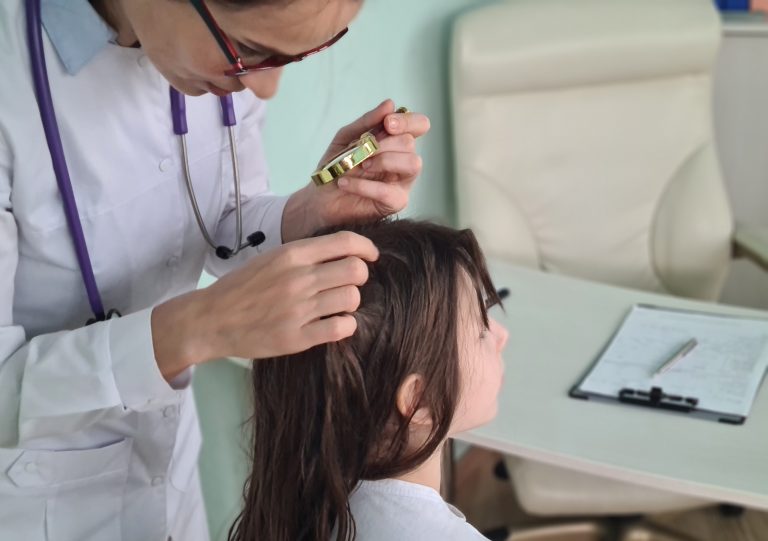
- You found one bug or one speck and honestly cannot tell: don’t guess your way into treating the wrong thing. The CDC says to see your healthcare provider if you are not sure, and a trained in-person head check can also sort it out.
There is a real gray area, and it is worth naming. A flea can bite a person, and specks in hair are easy to misjudge. The difference is what is attached and what is alive. Flea eggs fall out of hair; nits are held on by a sticky substance within about a quarter inch of the scalp, and the American Academy of Pediatrics test is that nits are firmly attached while dandruff, dirt or other particles are not. When a careful look finds no live louse and nothing firmly attached near the scalp, check the pet and the house next, and see a healthcare provider if you are still unsure. One more thing worth remembering: the CDC says getting head lice is not related to cleanliness of you or your environment, so neither answer here is a verdict on your housekeeping.
Frequently Asked Questions About Fleas and Lice
Can fleas live in human hair?
A flea can bite a person, but its life cycle does not run in human hair. Adult fleas spend most of their time on the dog or cat, not in the carpet, and the adult is the only stage that lives on the pet. Flea eggs are dry and smooth and easily fall out of hair, and the larvae develop beneath carpet fibers and furniture cushions instead.
Can you get lice from fleas or from a pet?
No. The CDC says head lice mainly spread by direct contact with the hair of a person infested with lice, and that animals do not get or spread head lice. The American Academy of Pediatrics says the main way head lice spread is close, prolonged head-to-head contact. Fleas and pets are not on either list. For the other direction, here is whether pets can get lice from a child.
Do fleas and lice look the same?
No, though the sizes overlap enough to cause doubt. A head louse is 2 to 3 mm, about the size of a sesame seed, and the American Academy of Pediatrics describes its body as usually pale and gray, with color that may vary. A cat flea is reddish-brown to black, wingless, and flattened from side to side. Use shape, color and movement together rather than size alone.
Do lice and fleas cause the same kind of itch?
They are not in the same place. The American Academy of Pediatrics says most of the itching from head lice happens behind the ears or at the back of the neck. The CDC says flea bites often occur on the lower legs and feet. One caution: the CDC also says people with head lice may not have symptoms, particularly with a first or light infestation, so no itch does not rule lice out.
Can flea products or pet medicine get rid of head lice?
No. The American Academy of Pediatrics is direct about it: never use medicines made for use on animals. It also says to check with your child’s doctor before beginning any head lice treatment, and that head lice medicine should be used only when it is certain that your child has living head lice. That is one more reason to confirm a live louse before you treat anything.
Not Sure What’s in Your Child’s Hair?
If you have looked, looked again, and still cannot call it, you do not have to keep guessing. A trained person can check the hair and tell you what is there. You can book a local head check with Lice Lifters of Chester County, and a professional lice screening will tell you whether there is a live louse on the head. If it is lice, our team can remove it in one visit. If it turns out to be fleas, you will know that too, and you can point your effort at the pet and the house instead of your child’s hair.